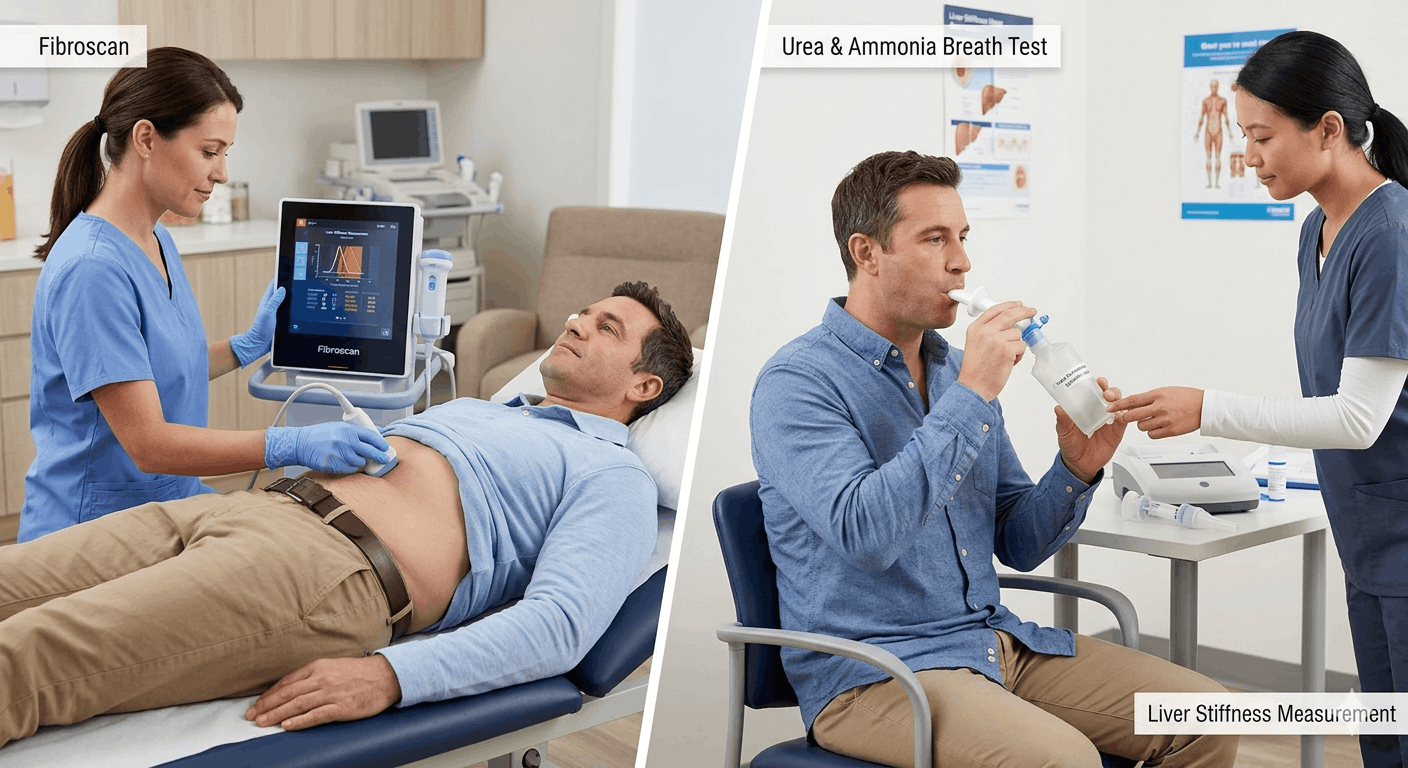
Fibroscan/Urea and Ammonia Breath Test
Overview
This comprehensive diagnostic package combines three essential tests for evaluating liver health and H. pylori infection:
- FibroScan – measures liver fibrosis and fatty liver
- Urea Breath Test (UBT) – detects H. pylori infection
- Ammonia Breathing – detects ammonia produced during UBT (alternative detection method)
These tests work together to provide a complete picture of digestive health, particularly for patients with liver disease, gastritis, and peptic ulcer symptoms.
1. FibroScan (Transient Elastography)
What is FibroScan?
FibroScan is a specialized ultrasound for your liver that uses transient elastography to measure liver fibrosis (scarring) and steatosis (fatty change) without requiring a biopsy. It measures liver stiffness and fat content non-invasively.
2. Urea Breath Test (UBT)
What is Urea Breath Test?
The urea breath test (UBT) is a rapid, non-invasive diagnostic procedure that detects Helicobacter pylori (H. pylori) infection in the stomach. H. pylori is a spiral bacterium that causes gastritis, gastric ulcers, and peptic ulcer disease.
3. Ammonia Breath Testing (Alternative Detection Method)
What is Ammonia Breath Testing?
Ammonia breath testing is an innovative approach to detecting H. pylori infection by measuring ammonia (rather than labeled carbon dioxide) in the breath.